
The perfect project plan is the one that actually gets executed.
Months of preparation. A task list built to cover every scenario, every dependency, every sequence. A PDF that represents the definitive version of how this project gets done.
Then it goes out by email.
And that's where the control ends.
Some locations open it. Some don't. Some start the work; others are waiting to hear back about something. The PM sends a follow-up to find out who's actually engaged, then a second follow-up for the locations that didn't respond to the first. One-off exceptions start surfacing, situations no one accounted for in the original list, and they're handled in separate threads that nobody else can see. A task needs a clarification, so a new version goes out. V2 reaches most locations. A few are still working from V1. Nobody knows who has what.
The plan didn't fail because it was bad. It failed because the format it lived in, email, spreadsheets, PDF, manual follow-up, was never built to carry it.
Pacer is. And it means you don't have to spend months building the perfect plan before you can launch it.
Details sharpen in the field. Best practices emerge mid-rollout. A step gets missed at location 12 and the fix needs to reach locations 13 through 300 before they make the same mistake. In Pacer, you make the change once, and it goes everywhere it belongs, automatically. The project launches when it's ready, and it gets sharper as it runs.
Update once. Pacer takes care of the rest.
Change a task. It updates everywhere it lives.
Refine an instruction. Clarify a prerequisite. Add steps based on what you learned from the first ten locations. Change the T-minus days on a task because the sequencing needed to shift.
Make the change once on the Baseline. Pacer automatically propagates it to every location that task has been assigned to, and recalculates every due date based on each location's own go-live date. Location A opens on the 1st. Location B opens on the 15th. One change, two correct due dates, no manual work.
Add a new task mid-project. It goes exactly where it belongs.
The project is live. A new requirement surfaces, a compliance step, a best practice that emerged from early locations, a process improvement the team identified in the field. You add the task to the Baseline: define the instruction, set the T-minus window, and specify which locations it applies to. Not all locations are in scope for every task, and Pacer doesn't pretend otherwise.
Pacer adds the task to the right locations, calculates the start and due dates against each location's go-live date, and notifies the relevant teams. No location has to wonder if they missed a version.
Build process improvement as your projects progress.
Launch faster. You don't have to perfect the project before publishing it. Get the right structure in place, assign the Baselines, and launch. Pacer handles the updates as the detail sharpens.
Finish earlier. Locations aren't stalled waiting for instructions to trickle in through email. The task is there, the instruction is current, and the due date is right. Teams move.
Eliminate version drift. No email chains, no PDFs with revision numbers in the filename, no “which version are you on?” conversations. There is one version. It lives in Pacer. Every location has it.
Standardize what you learn in the field. The rollout itself is a source of insight. When early locations surface better approaches, those become the standard for the locations still in progress. The project finishes stronger than it started.
Give every team a task list they trust. A team that receives a well-written task with a correct due date does the work. A team that receives a vague task with a date that clearly wasn't calculated for their location starts asking questions before they start working. Trust in the list is a multiplier.
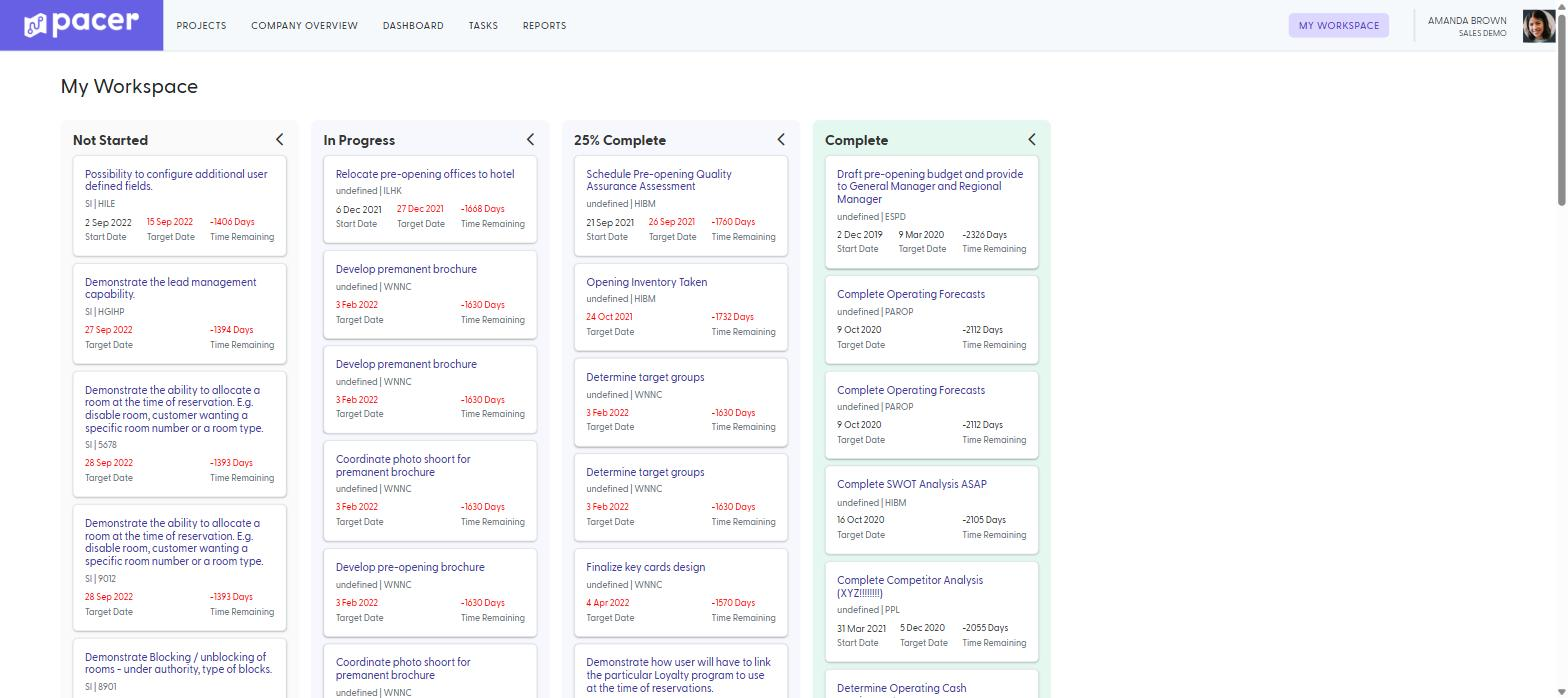
Build process improvement as your projects progress.
Launch faster. You don't have to perfect the project before publishing it. Get the right structure in place, assign the Baselines, and launch. Pacer handles the updates as the detail sharpens.
Finish earlier. Locations aren't stalled waiting for instructions to trickle in through email. The task is there, the instruction is current, and the due date is right. Teams move.
Eliminate version drift. No email chains, no PDFs with revision numbers in the filename, no “which version are you on?” conversations. There is one version. It lives in Pacer. Every location has it.
Standardize what you learn in the field. The rollout itself is a source of insight. When early locations surface better approaches, those become the standard for the locations still in progress. The project finishes stronger than it started.
Give every team a task list they trust. A team that receives a well-written task with a correct due date does the work. A team that receives a vague task with a date that clearly wasn't calculated for their location starts asking questions before they start working. Trust in the list is a multiplier.
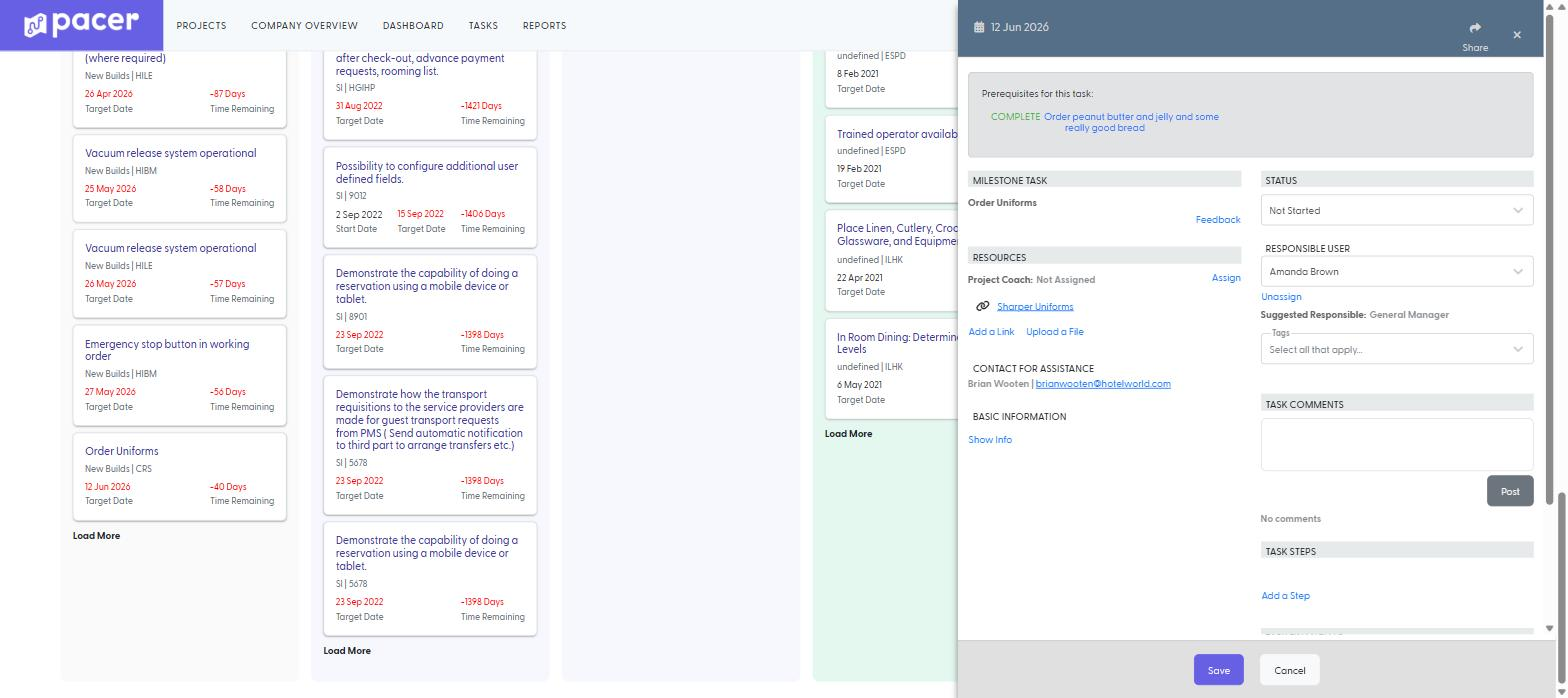
A project that runs across hundreds of locations should get smarter with every one.
The teams executing your project have direct knowledge of what works and what needs to change. Pacer's structure puts that knowledge on a direct line to the PM, and from there, to every location still in progress.
This is what it looks like when the standard isn't handed down once and forgotten. It's maintained, refined, and enforced, with every update reaching every location that needs it, automatically.