
Run Every Open Unit While You Open the Next One
Your first unit taught you how to open a location. Your fifth taught you that running what's open and opening what's next compete for the same hours in your week, and nobody besides you can see the whole portfolio at once. Pacer gives you one system for both jobs, so a stalling opening and a slipping standard at an existing unit show up before they cost you, not after.
The isolation nobody warns you about
Opening your first unit is straightforward: follow the checklist, hit the milestones, open on time. Opening your fifth, tenth, or twentieth is a different problem entirely. You're running the units that are already open while pushing the next ones toward their own opening date, and both jobs want the same hours.
Multi-unit operators often describe this stage as a kind of isolation. Your franchisor has a playbook for opening one unit. Nobody hands you a playbook for running fifteen while opening five, because that exact portfolio, at that exact stage, belongs to you alone.
Pacer runs both jobs in one system: what's operating and what's opening, on the same screen, so neither one quietly loses to the other.
Nobody built two separate tools to make this work. It's one portfolio, running one operator's business, seen in one place.
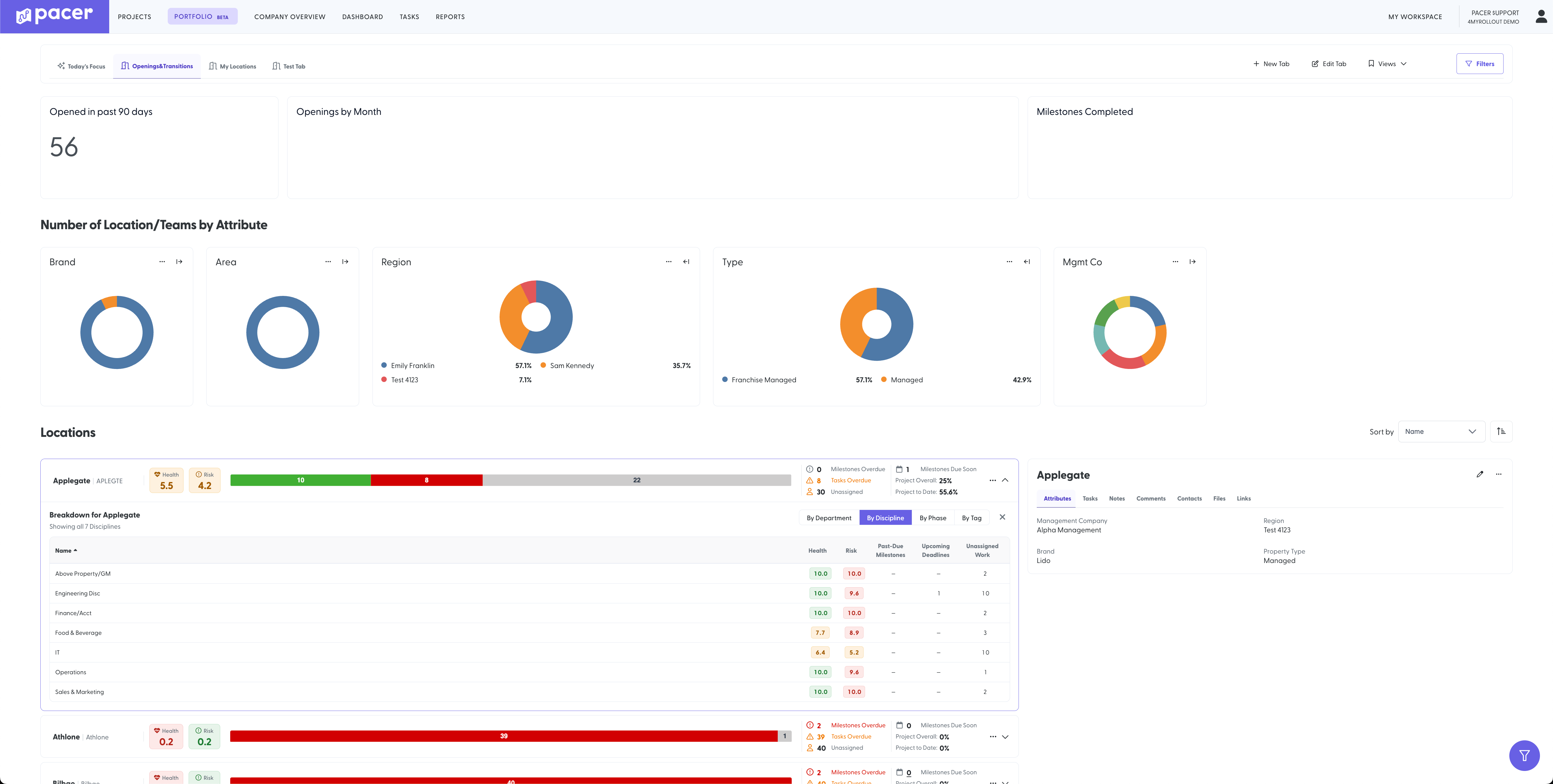
See every open unit and every unit in progress, without switching systems
Dashboard and Portfolio Health roll your operating units and your in-progress openings into one view, instead of one system for running the business and a separate spreadsheet for tracking what's still opening. Health and Risk Scores flag the unit that needs your attention today, whichever side of the portfolio it's on.
Know which unit is falling behind before the opening date does
A unit that's quietly stalling used to mean reading through its file on its own schedule. Pacer's aggregate reporting gives you a real-time view across every unit you operate, so a slipping task shows up as a risk score today instead of a missed date next month.
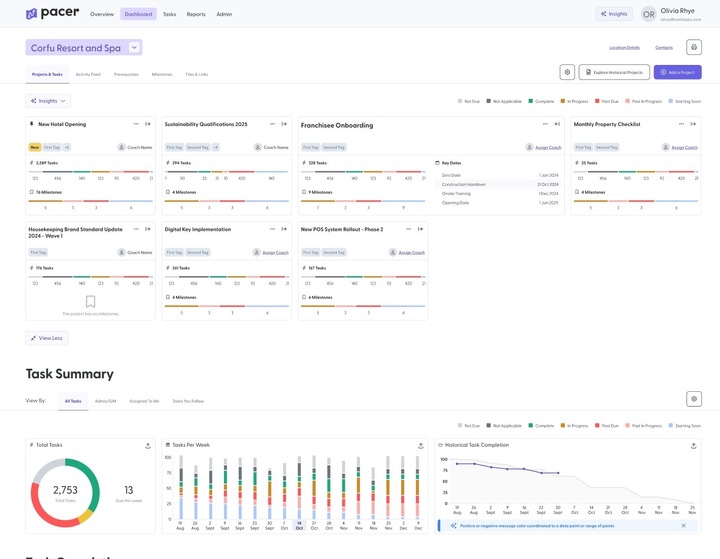
One number for your whole portfolio, not fifteen spreadsheets
A single unit's progress used to mean checking its own file, on its own schedule, in whatever format the manager on-site used that week. Multiply that across a growing portfolio, and you have no way to answer a basic question: how many of your units are actually on track to open this quarter.
Pacer rolls every unit's progress, open or opening, into the same view. No separate spreadsheet per location. No separate system to reconcile before a Monday morning check-in. Your whole portfolio runs on the same standard, visible the moment anything changes.
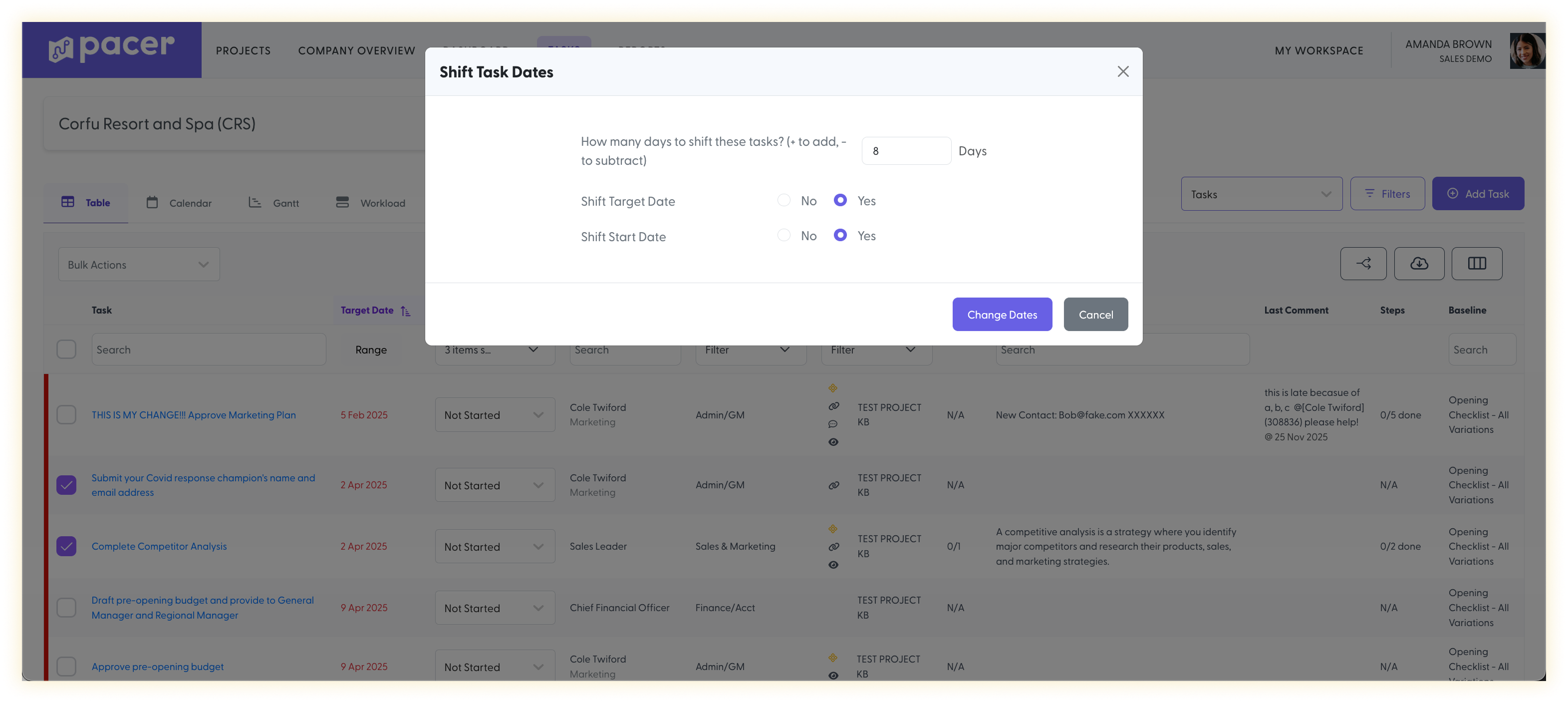
Move an opening date and every dependent task recalculates itself
Permits slip. Contractors reschedule. When an opening date moves, Pacer's T-minus scheduling recalculates every dependent task off the new date automatically, instead of you or your team manually re-dating a checklist for the unit that just changed.
Push a process update to every unit at once, instead of rebuilding it unit by unit
One master-linked template pushes to every unit you operate and updates all of them when it changes. Refine your opening checklist once after unit six, and units seven through twenty inherit the fix automatically, no re-sending a new version to whoever's opening next.
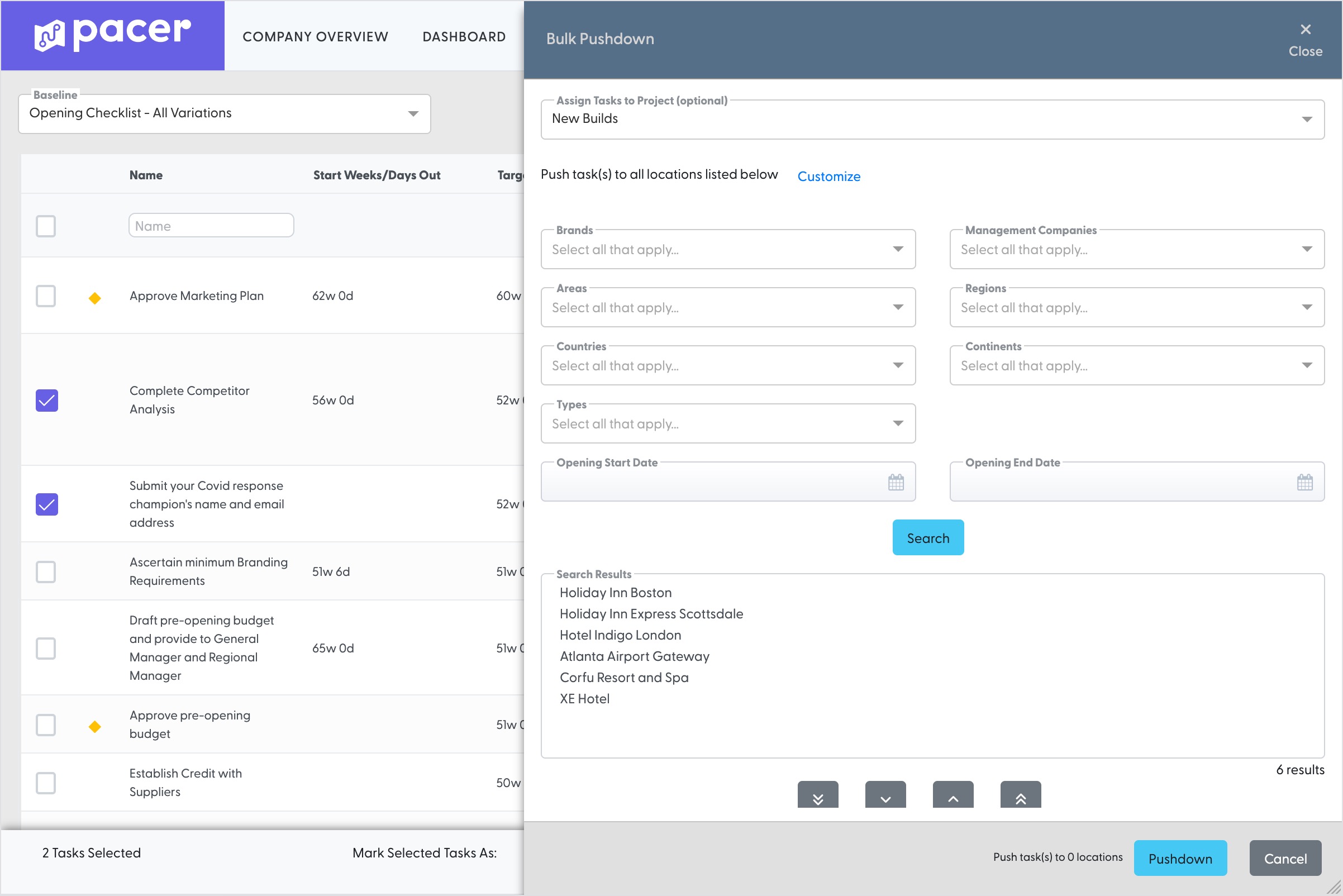
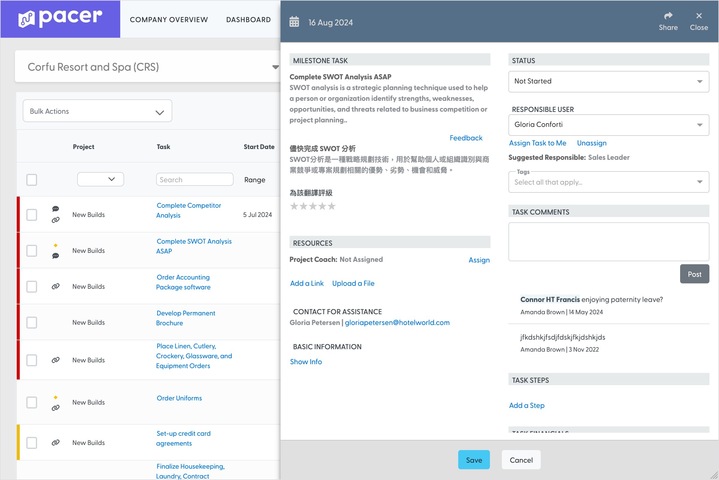
Manage every unit's local details without losing your standard process
Every market you operate in has its own permitting timeline, local vendors, and regulations. Pacer lets you customize tasks and attributes per unit while keeping the underlying template consistent, so local reality doesn't mean rebuilding your process from scratch every time you sign in a new market.
What they say
Real results from Pacer clients.
"We use this software to track progress and tasks for opening new hotels with Marriott and Choice brands. The software is very user friendly, easy to navigate, and is great at keeping your team on target."
"Amazing for project management, integrated with our corporate business. Pacer easily allows our team to keep track of tasks for new projects and monitor milestones, I have use it for a couple of years and it is a great resource."
"We rolled out this tool during the pandemic and took it from nonexistence in our company to 1,000's of users in a matter of days. The overwhelming comments have been extremely positive. The simplicity of use for people that have never seen it before. There is really no training necessary. The tool is very intuitive and you can't break it!"
One fixed rate, no matter how many units you're running
Your unit count doesn't grow in neat increments. You might sign five development agreements at once. Enterprise pricing means your Pacer cost doesn't have to keep pace unit by unit.
- Every unit, every manager, every project team included under one flat rate. No per-unit math as you add locations.
- A fixed monthly cost locked in for a full year, so budgeting for your next round of openings doesn't mean re-negotiating pricing every quarter.
- Run five units or fifty this year. Your Enterprise rate doesn't change.
Everything you need to run and open units at the same time
Pacer was designed to do what every multi-unit operator needs: run today's units and open tomorrow's, without either one falling through the cracks.
Task management that sticks
Assign work across every unit, set deadlines, and watch completion rates climb as accountability becomes automatic.
Real-time team visibility
See who is doing what across every unit and every department, without a status call for each one.
Compliance and records
Keep inspections, certifications, and safety logs for every unit in one place where you and your franchisor can both find them.
Questions
Find answers about running Pacer across the units you operate
Pacer was built specifically for operators running and opening physical locations at the same time, not generic project boards. It gives owners, GMs, and the team running day-to-day work one system to plan, track, and execute in real time across every unit. We work with multi-unit operators across restaurant, health and wellness, and hospitality brands, and can be configured to your specific portfolio to give you a single view of project status across every location.
Yes. We can import your users, units, and templates into Pacer directly. During implementation, your dedicated Customer Success Manager will help with this, including migrating active projects and task statuses so your team doesn't redo completed work.
Yes, we offer a comprehensive opening checklist as a starting point. Most operators customize it to their own units or use it to verify their existing process. Each opening feeds a feedback loop back into your master template, so the lessons from unit twelve are already built in by the time you open unit thirteen.
Yes. Notifications and reminders go out automatically, and you can set up scheduled emails listing past-due tasks at whatever frequency you want, rolled up across every unit you operate.
Yes. You see your entire portfolio, with aggregated data across every open unit and every unit in progress. Access updates automatically as you add or remove locations, so nobody has to manually re-grant permissions every time you sign a new unit.
You can mark specific tasks as milestones, which get tracked and monitored more closely than a standard task. That keeps the steps that actually protect your agreement, your licensing, and your brand standard from slipping quietly as your unit count grows.
A dedicated Pacer Customer Success Manager configures your environment, trains your team, and sets up your master templates. Most operators are fully operational within 3 to 6 weeks, and some are running in as little as 48 hours.
Yes. Pacer offers APIs to create and edit users, access rights, and locations based on data from your other systems, and can push Pacer statistics into other applications. Webhooks notify other systems when a task's status changes, and we support Single Sign-On to simplify and secure access for your team.
Yes. Attachments are supported on any task, and every file is visible on that unit's dashboard. Pacer also includes a file approval workflow for anything that needs review before it counts as done.
Pacer supports above-unit roles, unit-level roles, and vendor access, using Communities and baselines to control exactly who sees which tasks. We're happy to walk through the setup that fits how your organization is structured.
Need more clarity?
Our team knows multi-unit operations inside and out