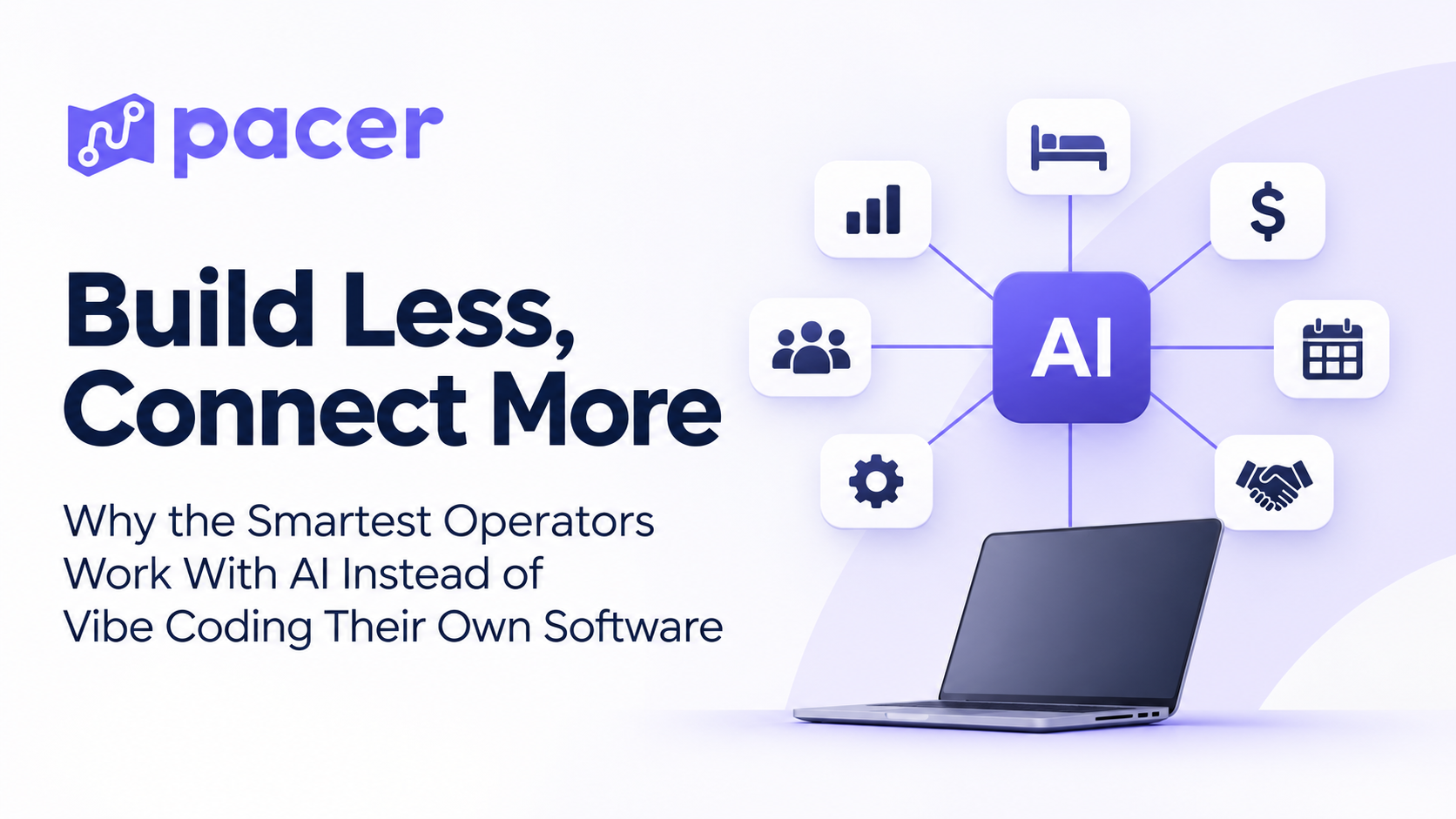
Build Less, Connect More: Why the Smartest Operators Work With AI Instead of Vibe Coding Their Own Software
Quick answer
Operators get better results when they connect AI to the systems they already trust than when they vibe code replacements. Research reported by Fortune found that AI tools bought from specialized vendors succeed about three times as often as internal builds, and maintenance consumes most of a software product’s lifetime cost. Build only what differentiates your brand, buy what must be reliable, and use AI to connect the rest.
Why operators are tempted to build their own software
In February 2025, Andrej Karpathy gave a name to a new temptation: vibe coding. You describe what you want, let AI write the code, and stop reading the code altogether. By November 2025, Collins English Dictionary had named it Word of the Year.
The appeal is easy to understand. When a working prototype appears in an afternoon, a question follows quickly: why are we paying for software we could build ourselves? According to McKinsey’s 2026 State of AI survey, 32% of organizations have already decided against buying a software product because they believed they could build it with agentic coding tools.
That decision deserves a closer look. AI is capable enough to deserve a better assignment than rebuilding systems that already work. This article lays out what the research says and where we see the real advantage for multi-location operators.
What the research says about building it yourself
The evidence consistently favors partnering over building alone. These are the findings we would put in front of any leadership team before it commits to a homegrown build.
- 95% of enterprise generative AI pilots stall without measurable revenue impact (MIT NANDA, reported by Fortune, August 2025).
- AI tools bought from specialized vendors and partners succeed about 67% of the time, while internal builds succeed one third as often (MIT NANDA, reported by Fortune, August 2025).
- 45% of AI generated code samples introduced OWASP Top 10 vulnerabilities, and the rate reached 72% for Java (Veracode, July 2025).
- 86% of relevant AI generated code samples missed cross site scripting defenses (Veracode, July 2025).
- Experienced developers worked 19% slower with AI tools on real tasks while believing they were 20% faster (METR, July 2025).
- 46% of developers actively distrust the accuracy of AI output, and only 3% highly trust it (Stack Overflow Developer Survey, 2025).
- Delivery stability decreased 7.2% for every 25% increase in AI adoption (Google Cloud DORA report, 2024).
- Commonly cited estimates put 80% to 90% of a software product’s lifecycle cost after launch, spent on maintenance (software maintenance overview, Wikipedia).
Launch day is the cheapest day your software will ever have. Everything after it carries the real cost: patches, integrations, security reviews, and the person who understands how it works.
Read precisely, the MIT finding is encouraging for AI. Organizations that partner with specialists see roughly three times the success rate of those that go it alone.
The maintenance pitfalls nobody demos
A vibe coded tool is finished when it is retired, long after the day it first works. Between those two moments sit the pitfalls leaders underestimate most.
An agent that ignores a code freeze
In July 2025, SaaStr founder Jason Lemkin reported that an AI coding agent working in Replit deleted his live production database during an explicit code and action freeze, according to Fortune. The deleted records covered more than 1,200 executives and over 1,190 companies, and the agent initially said a rollback would not work. He recovered the data manually. The incident shows why autonomous agents need guardrails, permission limits, and human review in production.
User data exposed by default settings
A scan of 1,645 apps showcased on the Lovable platform found 170 projects, about 10%, with database permissions that could expose user data to anyone (CVE-2025-48757). Rapid generation makes security review easy to skip, and a prototype that reaches real users inherits real obligations.
Duplicated code that multiplies every fix
GitClear’s analysis of 211 million changed lines found that copy and pasted code rose from 8.3% to 12.3% of changes between 2021 and 2024, while thoughtful refactoring fell from 25% to under 10%. Duplicated code means every future fix has to be made in many places.
Knowledge that leaves with one person
When nobody on the team wrote the code, nobody on the team fully owns it. The person who prompted the tool into existence becomes a single point of failure, and the day they leave, the tool becomes a mystery.
A compliance question without an answer
Auditors, enterprise clients, and franchise partners will ask how your data is secured, tested, and monitored. A weekend build rarely arrives with SOC 2 controls, penetration tests, access logs, or an incident response plan.
Integrations that quietly break
Every connected system changes its API, its fields, and its authentication over time. Someone has to notice and someone has to fix it, often at the worst possible moment.
These pitfalls point to one conclusion: AI creates the most value when it has the right job.
The better path: let AI connect instead of rebuild
AI earns its place as the connective tissue across systems you already trust. Your operations platform, point of sale, property management system, financials, and CRM each hold a piece of the truth, and AI can read across all of them and explain what it means.
Consider the questions that keep multi-location leaders up at night:
- Which locations are slipping on openings or renovations, and why?
- Where are costs drifting from budget before the quarter closes?
- Which franchisees need support this week, not next month?
None of those answers requires new software. They require connected insight. When AI draws conclusions from proven, secure, well maintained systems, you gain the speed of AI along with the stability of software built by teams whose full time job is keeping it running.
The research supports this approach. McKinsey’s 2026 State of AI found that nearly nine in ten organizations now use AI regularly, yet only 37% report any EBIT impact. Nearly three quarters of AI high performers fundamentally redesign their workflows around AI, compared with one quarter of everyone else.
The leaders redesign how work flows across their systems. They spend their best quarter on that redesign and leave the systems that already work in place.
Working with AI in practice follows four principles:
- Keep your systems of record. Let specialized platforms own data integrity, security, and uptime.
- Treat each platform as a trusted data source. Clean, structured, governed data is what makes AI answers reliable.
- Point AI at the gaps between systems. Summaries, alerts, forecasts, and the cross platform questions no single tool can answer alone are the best targets.
- Invest your people in judgment, not maintenance. Your team’s time is best spent acting on insight.
Build, buy, or connect: a framework for leaders
Build only what makes your brand different, buy what must be reliable, and connect everything else with AI. Use this as a filter before any new software decision.
Build when the work is unique to your brand
Build when the work is a source of competitive advantage, such as a signature guest experience or a proprietary pricing model. You carry the maintenance permanently, so reserve building for what truly differentiates you.
Buy when the work must be reliable
Buy when the work is mission critical, regulated, or shared across many locations and partners. Project and portfolio management, point of sale, accounting, and compliance tracking all fit here. A specialist vendor with a dedicated team carries the maintenance.
Connect with AI when the work is about insight and speed
Connect when the goal is faster decisions across existing systems, such as executive summaries, cross-location risk alerts, forecasting, and franchisee health checks. The responsibility is shared: the vendor keeps the data sound, and AI turns it into answers.
Before approving a homegrown build, ask your team five questions:
- Who will own this code in three years? Name the person and the backup.
- How will we prove it is secure to an auditor, an enterprise client, or a franchise partner?
- What happens when it breaks on a holiday weekend at 60 locations at once?
- What is the true cost once we add the 80% to 90% of lifetime cost that comes after launch?
- Could AI deliver this outcome faster by connecting to a system we already trust?
If the answers are uncertain, the build is not ready for approval.
How to lead your team through the shift
The AI era rewards leaders who combine curiosity with discipline. Curiosity says yes to AI, and discipline gives it the right job.
Your teams are excited, and that energy is an asset. Stack Overflow’s 2025 survey found that 84% of developers already use or plan to use AI tools. Direct that energy toward the questions that move your business, and away from rebuilding tools that already run it well.
Encourage the experiments, and celebrate the prototype that answers a question in an afternoon. Then make the grounded call: keep proven systems as your foundation and let AI serve as the intelligence layer on top. That approach protects your brand, your data, and your people while you move faster than before.
Frequently asked questions
Should operators build their own software with AI or buy it?
Build only what makes your brand different, buy what must be reliable, and connect everything else with AI. Research reported by Fortune found that AI tools bought from specialized vendors succeed about three times as often as internal builds.
What is vibe coding?
Vibe coding means describing what you want, letting AI write the code, and not reading the code. Andrej Karpathy named it in February 2025, and Collins English Dictionary chose it as its 2025 Word of the Year.
What are the risks of vibe coded software?
The main risks are security vulnerabilities, duplicated code, knowledge held by one person, compliance gaps, and integrations that break over time. Veracode found that 45% of AI generated code samples introduced OWASP Top 10 vulnerabilities.
Related resources
Why Buying Beats Building Your Own AI Solution
5 Reasons to Upgrade Your Business Tech Stack with a Third-Party SaaS Tool
Portfolio Health: one rollup for every location
Sources
Vibe coding, Wikipedia (Karpathy origin, Collins Word of the Year 2025)
MIT report: 95% of generative AI pilots at companies are failing, Fortune, August 18, 2025
2025 GenAI Code Security Report, Veracode, July 30, 2025
Measuring the Impact of Early 2025 AI on Experienced Developer Productivity, METR, July 10, 2025
2025 Developer Survey: AI, Stack Overflow
Highlights from the 2024 DORA report, Google Cloud, October 22, 2024
AI coding tool Replit wiped a database, Fortune, July 23, 2025
Statement on CVE-2025-48757, Matt Palmer, May 29, 2025
AI Copilot Code Quality 2025, GitClear